


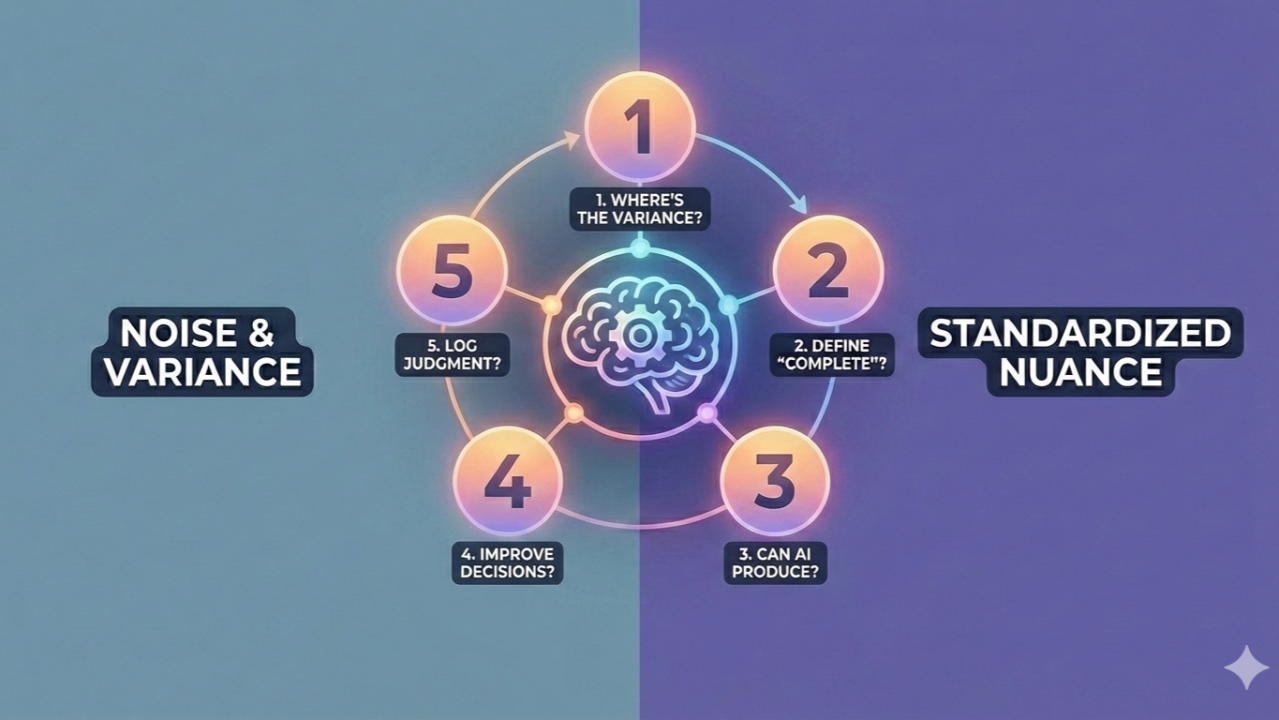
My 5-question framework for deciding where to apply AI in B2B marketing workflows in 2026
I recently came across a University of Chicago study on AI-assisted hiring, and it unexpectedly clarified how I think we should approach AI in B2B marketing workflows in 2026.
Not “where can we bolt AI onto what we already do,” but: where is human variance degrading data quality, slowing decisions, and creating avoidable rework—and how can AI standardize that without stripping away strategic judgment?
I’ll break down how I got there in a moment. But I don’t want to bury the lead, so here’s the framework upfront.
The 5-Question Framework for Applying AI in B2B Marketing Workflows
- Where is human variance degrading the signal? Tell “We have ‘great meetings’ but unclear ICP fit.” “We can’t compare performance across campaigns.” “Every brief kickoff starts from scratch.”
- Can you define what “complete + comparable” looks like? This is your rubric/schema step: required fields, definitions, and what “done” means.
- Can an AI reliably produce the artifact inside guardrails? Think “controlled variance”: flexible language, fixed structure. AI can adapt, but the outputs need consistent shape.
- Does the artifact materially improve downstream decisions? If the standardized output doesn’t change routing, prioritization, messaging, or investment decisions, it’s likely busywork automation.
- Can you log human judgment so the loop becomes auditable? This is the sobering part: if human decisions aren’t captured, they can reintroduce invisible variance, limiting your ability to improve the system over time.
The Recruitment → B2B Marketing Connection
I found the study while reading LinkedIn’s “25 Big Ideas for 2026,” including the claim: AI will make recruitment fairer and more transparent. That made me skeptical. Public sentiment about AI in hiring often skews negative, especially around automated screening, resume optimization, and opaque “why did I get filtered out?” experiences.
So I dug into the underlying research.
In the study, job applicants were interviewed either by a human or by an AI voice agent. Results were notable: AI interviews led to more job offers, more job starters, and higher early retention. Importantly, those outcomes weren’t just because “AI fans chose AI.” The headline stats come from the random-assignment comparison.
Even more interesting: humans still made the final hiring decisions, based on the interview recording and transcript.
That separation is the key. It suggests the upside wasn’t “AI replacing human judgment.” It was AI improving the information-collection step, producing more consistent, comparable candidate data for humans to evaluate.
Applying the Framework to B2B Marketing Workflows
This is where it clicked for me. In B2B marketing, information collection is everywhere, and it’s often where things break.
In the study, the AI interviewer followed the interview guide more consistently (more topics covered, more consistent ordering, closer-to-guideline wording), while still handling follow-ups and back-and-forth. The authors describe this as controlled variance: adaptive conversation inside a standardized structure.
In short:
Better, more comparable info collected early → better downstream human decisions → fewer bad fits.
AI was used to standardize the noisy stage, while preserving the nuance of the human decision stage.
Now let’s make that concrete for B2B marketing.
Lead and account qualification (the hiring analogue)
Noisy stage
- SDR discovery notes vary wildly by rep; fit and ICP alignment are inconsistently captured
AI role (intake standardization)
- Run a structured discovery interview
- Extract required fields consistently (use cases, urgency, stakeholders, environments, constraints, objections)
- Flag missing info
- Produce a comparable “account profile” for every conversation
Human role (judgment)
- Sales/marketing decides the next best action (pursue, nurture, disqualify)
- Logs rationale so the system is auditable and improvable
This is basically AI interviewer + human hiring manager, but for accounts.
Creative/content briefing (stop losing signal at the start)
Noisy stage
- Briefs are incomplete, subjective, and different every time
AI role
- Run a standardized brief intake (asks the question you wish everyone asked)
- Check for gaps (proof points, buyer stage, objections, CTA)
- Output a brief in a consistent template
Human role
- Strategy and creative teams inject nuance, weigh tradeoffs, and own final positioning
This increases speed and quality, because teams stop reinventing the same intake meeting.
Experimentation and performance analysis (reduce measurement chaos)
Noisy stage
- People tell stories with cherry-picked metrics; attribution is messy; debriefs are inconsistent
AI role
- Standardize campaign results packages (same metrics/KPIs, same time windows, same segmentation)
- Identify anomalies and likely drivers
- Draft a hypothesis with a confidence level
Human role
- Validate assumptions, add context (market changes, field feedback), decide what to change
This is controlled variance applied to marketing performance measurement.
The Path Forward
AI is everywhere, but in many ways we’re still early. Today’s copilots (research help, writing assistance, ideation) are valuable, but they’re a fraction of what’s possible when we re-architect workflows around AI from the ground up.
The hard work is not “using AI more.” It’s dissecting the workflows we’ve run for years, identifying where human variance creates noise, and then designing systems that standardize the inputs while preserving strategic judgment.
It’s like the early days of social media: first it was simple posting and connection. Now platforms are full ecosystems driving commerce, perception, and entirely new business models. We didn’t get there overnight, and we won’t with AI either.
But if you start evaluating your workflows through this lens—where can noise be standardized and nuance preserved—you’ll set yourself up to lead in the next phase of B2B marketing.